





What certifications are required for exporting electric pressure cookers to different countries?
There is a good prospect in exporting electric pressure cookers in the current global kitchen appliances market. As the demand increases in more than 70 countries across the globe, producers and exporters can only know one important thing; compliance in product certification. Your products may be rejected at the border, fined or prohibited without the necessary certifications.
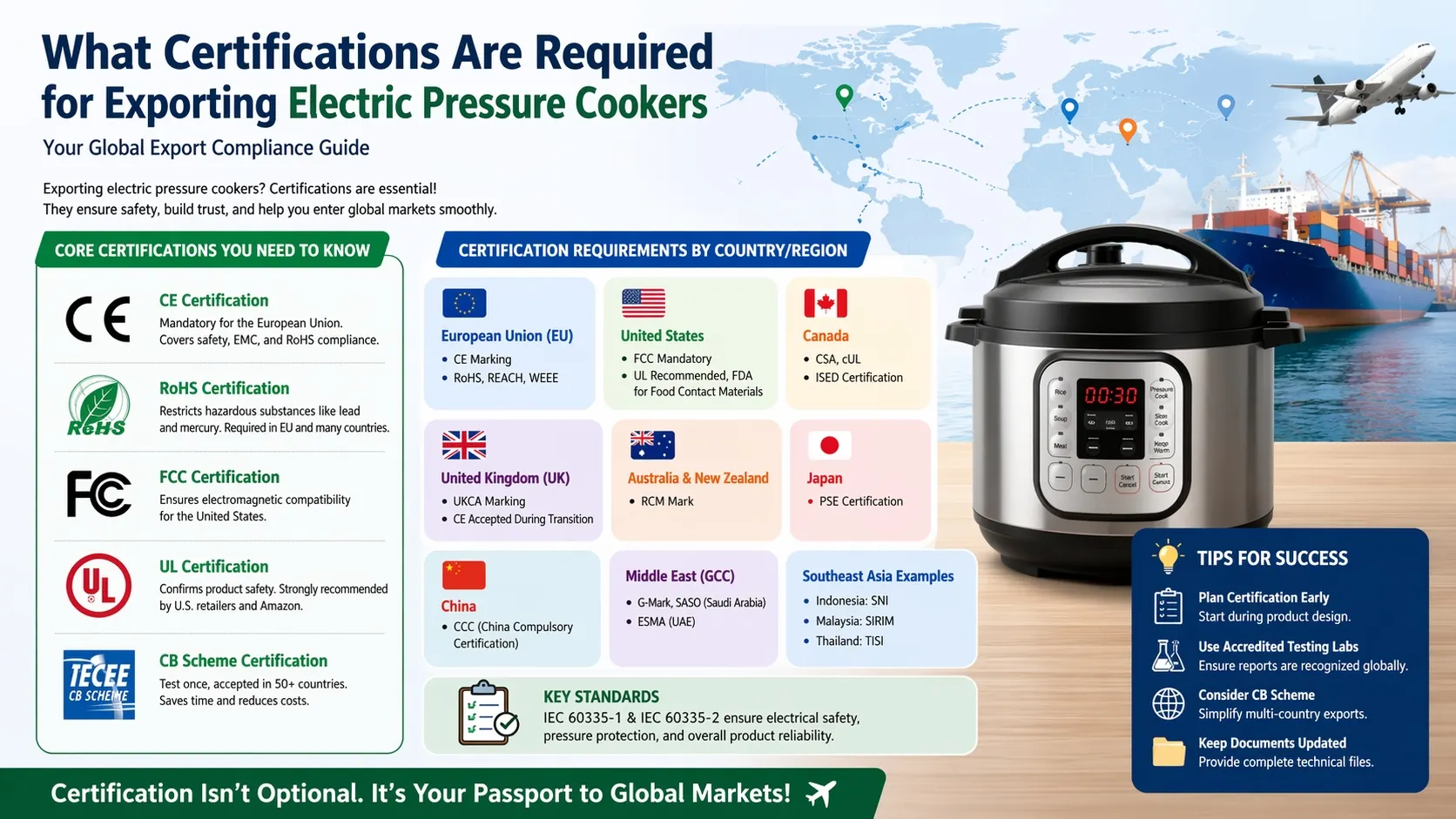
This guide will be used to explain the necessary certifications that will be needed to export electric pressure cookers to some of the largest markets in the world without breaking any laws.
Why Certifications Matter in Global Trade
Electric pressure cookers fall under electrical household appliances, meaning they must meet strict regulations for:
- Electrical safety
- Electromagnetic compatibility (EMC)
- Environmental protection
- Food-contact safety
Certifications serve as proof that your product meets these standards. In many countries, they are legally mandatory, not optional.
Additionally, certified products gain higher trust from buyers, distributors, and e-commerce platforms.
Core Certifications for Electric Pressure Cookers
Before diving into country-specific requirements, let’s look at the most common global certifications.
1. CE Certification (European Union)
In order to sell electric pressure cookers in Europe, the CE marking is necessary. It verifies that the product is in line with EU safety, health and environmental requirements.
In the case of kitchen appliances, CE compliance typically involves:
- Low Voltage Directive (LVD)
- Electromagnetic Compatibility (EMC)
- RoHS Directive
Without CE marking, your product cannot legally enter the EU market.
2. RoHS Certification
RoHS (Restriction of Hazardous Substances) is a measure that assures that electrical products are free of harmful substances like lead, mercury or cadmium.
It is mandatory in:
- European Union
- Many global markets adopting EU standards
RoHS is often a required component of CE compliance.
3. FCC Certification (United States)
Provided your electric pressure cooker has electronic parts that are able to emit electromagnetic signals (e.g., digital displays or smart functions), it should meet the FCC regulations.
FCC certification ensures:
- No interference with other electronic devices
- Compliance with U.S. communication standards
4. UL Certification (United States)
UL (Underwriters Laboratories) certification focuses on product safety, including:
- Fire hazards
- Electrical risks
- Mechanical safety
UL is not mandatory, but it is frequently obliged by retailers or platforms, such as Amazon, and hence practical.
5. CB Scheme Certification (Global)
The IECEE CB Scheme allows manufacturers to test a product once and use the results across multiple countries.
Benefits include:
- Reduced testing costs
- Faster market entry
- Acceptance in 50+ countries
This is especially useful for exporters targeting multiple regions.
Certification Requirements by Country/Region
Certification requirements vary significantly depending on your target market.
European Union (EU)
To export electric pressure cookers to Europe, you must have:
- CE Marking (mandatory)
- RoHS Compliance
- REACH (chemical safety, if applicable)
- WEEE (electronic waste compliance)
CE acts as a passport for entering all EU member states.
United States
For the U.S. market, key certifications include:
- FCC (mandatory for electronic components)
- UL or ETL (strongly recommended)
- FDA compliance (for food-contact materials)
Retailers often refuse uncertified products, even if not legally required.
Canada
Canada has its own certification system:
- CSA (Canadian Standards Association)
- cUL (Canadian version of UL)
- ISED certification (similar to FCC)
United Kingdom
Post-Brexit, the UK introduced:
- UKCA marking (replacing CE)
- CE marking still accepted during transition
Requirements are similar to EU standards.
Australia and New Zealand
Exporters must comply with:
- RCM (Regulatory Compliance Mark)
This combines:
- Electrical safety
- EMC requirements
Japan
Japan requires:
- PSE certification (Product Safety Electrical Appliance & Material)
This is mandatory for electrical appliances entering the Japanese market.
China
For domestic sales in China:
- CCC (China Compulsory Certification) is required
Middle East (GCC Countries)
Key certifications include:
- G-Mark (GCC conformity mark)
- SASO (Saudi Arabia)
- ESMA (UAE)
These ensure compliance with regional safety standards.
Southeast Asia
Certification requirements vary by country:
- Indonesia: SNI
- Malaysia: SIRIM
- Thailand: TISI
Many countries accept CB Scheme reports to simplify certification.
Key Technical Standards for Electric Pressure Cookers
Beyond certifications, electric pressure cookers must comply with international standards such as:
- IEC 60335-1 (household appliance safety)
- IEC 60335-2 (specific appliance requirements)
- EMC standards (interference control)
These standards ensure:
- Safe pressure handling
- Electrical insulation
- Overheat protection
Common Mistakes Exporters Should Avoid
Many exporters face delays or penalties due to avoidable mistakes:
1. Assuming One Certification Works Globally
CE certification does not replace FCC or UL requirements.
2. Ignoring Local Regulations
Each country has unique rules—even within the same region.
3. Outdated Test Reports
Some platforms require certification reports issued within 6 months.
4. Missing Documentation
Incomplete technical files can lead to customs rejection.
Tips for Successful Export Compliance
To ensure smooth international expansion:
- Start certification planning during product design
- Use accredited third-party testing laboratories
- Consider CB Scheme for multi-market exports
- Maintain updated technical documentation
- Work with local compliance experts
Market Opportunities for Certified Products
The global electric pressure cooker market is expanding rapidly, with major importers including:
- United States
- Vietnam
- Emerging markets in Africa and Southeast Asia
Certified products can command higher prices and attract premium buyers.
Conclusion
It is not only necessary to produce quality products when exporting electric pressure cookers but it is also necessary to adhere to strict international certification standards.
Exporters should concentrate on at least:
- CE and RoHS for Europe
- FCC and UL for the United States
- Local certifications for target markets
By understanding and meeting these requirements, businesses can:
- Avoid legal risks
- Build global trust
- Expand into high-value markets
In this day and age of unhealthy competition in global trade, certification is not only a necessity, it is a strategic tool.


