





2026 Electric Pressure Cooker Market Overview in Ghana
The Ghanaian electric pressure cooker market is adapting to urbanization and growing demand from the middle class for energy-efficient cooking devices. Rather than being disrupted, the market is developing through gradual adoption in urban and peri-urban areas.

By 2026, importers, distributors, and retailers will consider the electric pressure cooker a valuable addition to the West African small kitchen appliance market.
This article covers the key market drivers for electric pressure cookers in Ghana and presents buyer needs and assesses availability of suppliers and product development.
1. Key Drivers Shaping the Ghana Electric Pressure Cooker Market
The electric pressure cooker market is developing due to gradual adoption in comparison to abrupt market growth. There are lifestyle changes and structural factors that affect the market.
1.1 Urbanization and Demand for Time Efficiency
Growth of urban areas are seeing an abundant number of working professionals with an increasing number of dual income households. This increases the demand for appliances that reduces the time needed for cooking and helps to prepare meals that need less supervision.
1.2 Improvement of Energy Access through Electrification
Over the last decade, electricity coverage has reached urban and peri-urban areas. Delays to the electricity supply are still an issue in some areas. Electric cooking appliances are therefore an option that was not available a few years prior.
1.3 Preference for Multi-Use Appliances
The market offers more options for cooking appliances that perform more than one function. This trend is especially relevant for households that are living with a constrained budget.
1.4 Health and Nutritional Awareness
Pressure cooking has obtained a reputation that suggests it cooks food faster than other methods, while still keeping more nutrients intact. For this reason, it is becoming a popular tool among the health-focused consumers in urban areas.
1.5 Digital Influence on Consumer Behavior
Younger consumers are increasingly influenced by short-form video content on social media, particularly recipe videos and related appliance reviews.
Overall Insight:
The growth in market size has been gradual, and is the result of the steady changes in the structure of the market, rather than through a single, significant, market altering event.
2. Product and Buyer Preference Trends in Ghana
When it comes to Ghanaian consumer preferences, a product's practicality, durability, and price are more important to buyers than premium features. The following table lists trends in buyer preferences in Ghana.
| Category | Market Preference in Ghana |
| Capacity | 5L–6L is the standard for most households; 3L is for small households; a dual-pot system is a small niche. |
| Inner Pot Material | Stainless steel for durability, non-stick ceramic for ease of cleaning, and hard-anodized as a mid-range choice. |
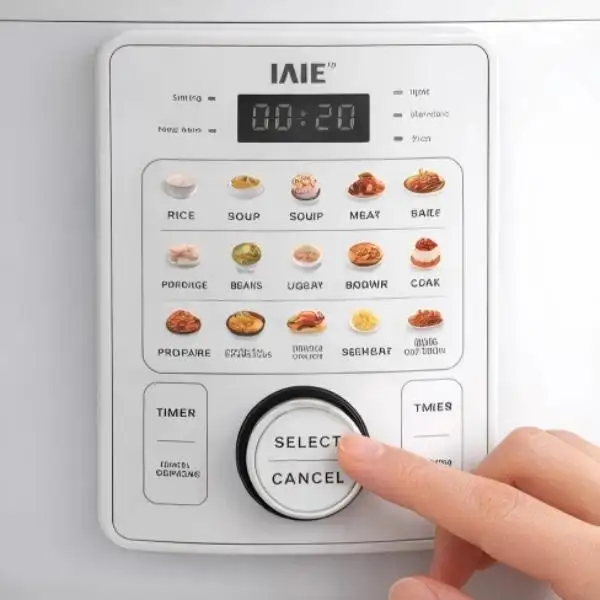
| Control Interface | LED/LCD is the standard, touch interfaces are in the mid/upper segments, and English/French UI is becoming more important. |
| Cooking Programs | Rice, beans, soup, stew, and vegetable cooking functions are the standards. Cooking modes (10–20+) for local recipes increase market competitiveness. |
| Safety Systems | Overheating protection, pressure release, and safety locks are standard. |
| Branding & Packaging | Differentiation on the retail shelf occurs through logos and local packaging. |
Key Market Assessment
The Ghanaian market will only accept products that reliably and affordably deliver essential functions. Products must also be user friendly and withstand the rigors of the local environment.
3. Supply-Side Capabilities and OEM/ODM Manufacturing Role
To enter the Ghanaian market successfully, most companies depend on flexible and scalable production from established OEM/ODM manufacturers.
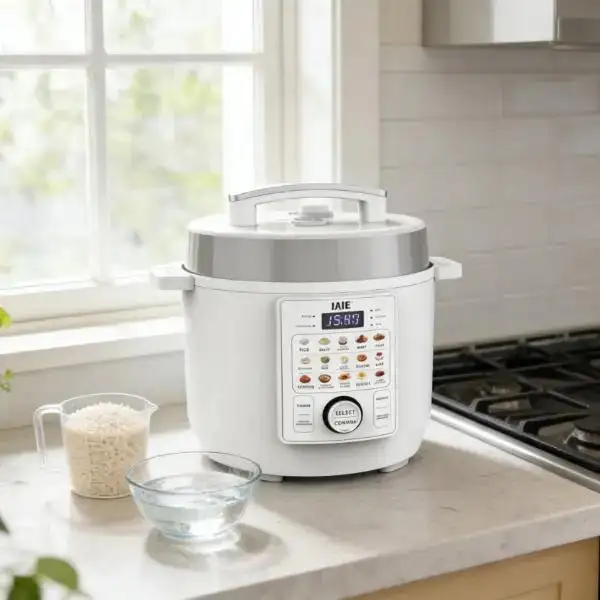
IAIE manufactures smart pressure cookers and offers flexible and scalable OEM and ODM services to global brands for the manufacture of electric pressure cookers including product design, tooling, production, and services related to certification compliance.
IAIE offers production services and modular partnerships that support differentiated brand strategies unlike other manufacturers.
3.1 Overview of Manufacturing and Production Capability
| Capability Area | Manufacturing Performance (IAIE) |
| Injection Molding Systems | Ability to perform large-scale injection molding with flexible production and short changeover times. |
| Product Range Flexibility | Offers flexibility from 3L to 8L in single and dual arrangements. |
| Control System Options | LEDs, LCDs, and touch screens; capacity for multiple languages. |
| Recipe Customization | Ability to program different modes of cooking for different regional foods. |
| Branding Support | Ability to apply logos or make embossing and produce different forms of packaging. |
| Production Lead Time | Standard OEM orders usually in 25–30 days, depending on specification. |
| Certification Coverage | Ability to produce under CE, CB, RoHS, UL, ETL compliance. |
4. Safety and Quality Compliance as Market Entry Requirement
Perception of product safety in Ghana directly influences brand acceptance. When product-related incidents occur, they have a high tendency to go viral in both social and community networks. Therefore, Quality Assurance (QA) is critical.
4.1 Quality Control Framework
A quality control system framework incorporates:
• Inspection of incoming materials (housings, heating elements, and electronic boards)
• Verification of assembly in-process
• Testing of control systems and of stability and safety of the sealed pressure systems
• Sampling inspection of the final output and of the batch.
4.2 Functional Testing Requirements
Typically, each unit is assessed for:
• Consistency of heating
• Accuracy of pressure control
• Functionality of the control system
• Safety and functionality of locking and release.
4.3 Industry Implication
For distributors, safety assurance translates directly to:
• Reduction of warranty costs
• Safeguarding of brand equity
• Retention of the retail right.
5. Product Customization as Competitive Differentiation
Given that the market is in the growth phase, customization should take precedence over complexity in the design of the product.
5.1 Capacity Segmentation Strategy
• Standard 5-liter household model
• Single-unit systems for the preparation of multiple dishes.
5.2 Local Recipe Adaptation
Development of specific cooking programs for:
• Waakye
• Jollof rice
• Groundnut soup
• Stews and soups
5.3 Interface Localization
• Use of English as the first language (with the possibility of a French interface for regional expansion)
• Touchscreen-based variable interface.
5.4 Packaging Localization
The packaging provides a means of:
• Signaling energy efficiency
• Communicating safety certification
• Improved shelf presence in retail outlets.
6. Market Forecast 2026 Onwards
In Ghana, the electric pressure cooker market is a slowly expanding category as opposed to a fully developed mass market.
Key Trends
• Growth is expected to be consistent, with no anticipated major spikes.
• Buyers will be sensitive to the cost.
• Reliability will be the most important factor in competition.
• Localization will be a key differentiator.
Brand Strategy Considerations
Success hinges on three areas:
• Reliable partners for manufacturing.
• A product configuration that is relevant to the local market.
• A distribution system that provides adequate support, and robust after-sales service.
Concluding Remarks
In 2026, Ghana should have a slight improvement in the reliability of electric pressure cookers. Though in the early stages of the market, demand will be supported by the increased use of electricity, the urban shift in lifestyle, and the greater variety of consumer products.
Manufacturers that are able to bring together quality manufacturing at a reasonable price and localized product design, will achieve the best long-term market position in a fast changing West African marketplace for consumer products, particularly electric pressure cookers.
IAIE invites you to explore the opportunities for OEM-ODM partnerships to develop your next-generation electric pressure cookers tailored for the African market.
FAQs
Q1. What does IAIE do?
IAIE specializes in OEM/ODM services for electric pressure cookers, as well as smart kitchen tools and appliances.
Q2. Will IAIE create products for private labeling?
IAIE will provide fully private labeled products with branding.
Q3. What IAIE product customization can be provided?
IAIE gives options for different product capacities, cooking programs, control panels, materials, and packaging.
Q4. Will IAIE accept a small order quantity?
Yes, IAIE has a flexible minimum order quantity based on the configuration of the product.
Q5. What types of product compliance and certification can IAIE provide?
Manufacturing can be supported for compliance and certificates such as CE, CB, RoHS, UL, and ETL.


