





how do pressure cookers work
Pressure Cookers are increasingly becoming one of the most popular kitchen appliances for the busy homes, professional chef and health conscious cooks alike. A pressure cooker can cut the cooking time up to six or seven times and maintain the taste and nutrients of beef stew, mouth-watering beans or fluffy rice.
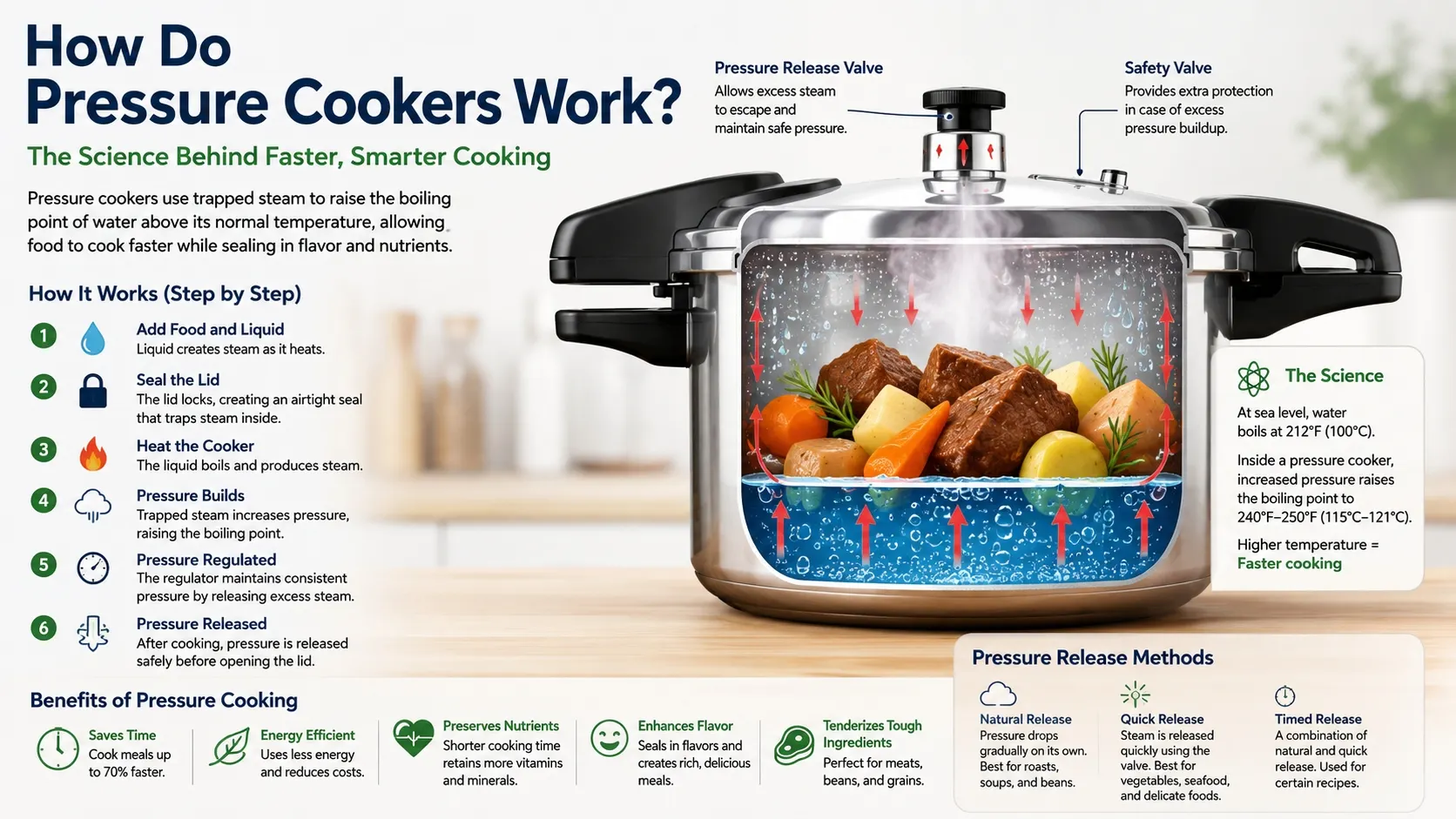
However, how does a pressure cooker work? How are they able to prepare foods in a matter of minutes when it takes several hours? Knowing the science of pressure cooking will help you to do a better job utilizing your pressure cooker and to get the best results every time.
Here you'll learn how pressure cookers work, the important parts, the advantages and safety features, and why they're a must have in the modern kitchen.
What Is a Pressure Cooker?
A cooking pot that is tightly sealed with a pressure cooker lid to enable steam to be retained when the liquid inside is heated. The higher pressure from the increased pressure of steam builds inside the pot, causing water to cook food at higher temperatures.
The pressure cooker will provide a controlled environment with both moisture and heat, in contrast with conventional pots where steam just rises up and thaws out in the air. This resulted in much quicker cooking times and greater energy efficiencies. Pressure cookers are designed to cook food quicker than it would normally cook, by trapping steam above the boiling temperature of water.
The Science Behind Pressure Cooking
To understand how a pressure cooker works, it helps to know a basic principle of physics:
Water Boils at Different Temperatures Under Different Pressures
The boiling point of water at sea level is 212°F (100°C). At this temperature, water will become steam.
The steam is allowed to be lost to the atmosphere in an ordinary pot. Temperature of boiling water does not get much higher than 212°F with the same amount of pressure.
However, steam is not able to escape from the pressure cooker. With the continued generation of steam, the pressure increases inside of the cylinder. The higher pressure keeps water in a liquid state at the higher temperatures, and sometimes as high as about 240°F to 250°F (115°C to 121°C). When the pressure is higher, the water boils at a higher temperature, allowing it to be cooked at temperatures approaching 250° F (121°C), which decreases cooking time a lot.
The result is simple:
- Higher temperature
- Faster heat transfer
- Reduced cooking time
Several hours can often be reduced to a fraction of that in the preparation of foods that usually take a few hours.
Step-by-Step: How a Pressure Cooker Works
1. Adding Food and Liquid
You need to add liquid, like water, broth or stock in every pressure cooker. As the liquid warms, the fluid expands and forms steam.When the liquid is warmed it turns to steam.
If there is no enough liquid, the cooker is not able to produce enough steam to create pressure.
2. Sealing the Lid
Uses a sealing ring or gasket to hold the lid in place on the pot. This is a sealed air tight unit that will not leak any steam.
If cooked chamber is closed, it becomes a closed environment.
3. Heating the Cooker
When the temperature increases, the liquid starts boiling and it will generate steam.
The steam is not released easily and builds up within the pot and increase the pressure inside the pot.
4. Pressure Builds
The higher the pressure, the higher the boiling point of the liquid will be.
Eventually the cooker reaches its operating pressure of approx. 10–15 PSI above atmospheric pressure.
Cooking starts at considerably higher temperatures at this point than the boiling temperatures normally used.
5. Pressure Regulation
Today your pressure cooker will have a pressure regulator to make sure it maintains the pressure.
Thanks to a small valve allowing for steam to be discharged without harm if pressure is too high or too low, the machine does not over pressurize.
6. Pressure Release
When the cooking process is finished the pressure has to be lowered and the lid can be opened.
It appears that there are three methods of release that most pressure cookers provide:
- Natural Release
- Quick Release
- Timed Release
The method used depends on the type of food being cooked.
Why Does Food Cook Faster?
Several factors contribute to the speed of pressure cooking.
Higher Cooking Temperatures
With higher pressure, the food can be cooked at much greater temperatures than if it were boiled normally.
The chemical processes that lead to the softening of vegetables, the breakdown of the connective tissue and tenderizing meat goes much faster.
Improved Heat Transfer
Dry air is not as good a heat transfer medium as steam.
Food's surrounded by hot steam within a pressure cooker that provides rapid, even energy.
Better Moisture Penetration
The high pressure aids entry of moisture into food.
This is particularly beneficial for:
- Tough cuts of meat
- Dried beans
- Whole grains
- Root vegetables
Pressure and steam are used to cook and tenderize foods more effectively because they force moisture into the food, helping to heat it up quickly and effectively.
Main Components of a Pressure Cooker
Understanding the key parts of a pressure cooker helps ensure safe and efficient operation.
Cooking Pot
The main vessel where food and liquid are placed.
Locking Lid
Creates an airtight seal and prevents opening while pressure remains inside.
Sealing Ring (Gasket)
Usually made from silicone or rubber, the gasket prevents steam leaks.
Pressure Release Valve
Controls pressure by allowing excess steam to escape safely.
Pressure Indicator
Shows whether pressure has built up inside the cooker.
Safety Valve
In the case of inappropriate building of pressures, offers an extra protection.
Today's pressure cookers feature several safety devices, including locking lids, pressure relief and safety valves.
Benefits of Using a Pressure Cooker
Saves Time
One of the biggest advantages is speed.
Many recipes cook 50–70% faster compared to conventional cooking methods.
Energy Efficient
Shorter cooking times mean lower energy consumption.
This can reduce household utility costs over time.
Preserves Nutrients
Because foods cook quickly with minimal water, many vitamins and minerals are better preserved.
Enhances Flavor
The controlled environment prevents aromas and flavours from escaping.
This makes them saucier and fuller in flavour.
Tenderizes Tough Ingredients
Typically, anything that is lowly in quality becomes tender and flavorful when simple cuts of meat are pressure cooked.
Are Pressure Cookers Safe?
It is still thought of by many as a broken model pressure cooker.
But present-day pressure cookers have a number of safety features.
Modern models on the market come with the following features:
- Automatic pressure control
- Lid-locking mechanisms
- Backup safety valves
- Steam release systems
- Pressure monitoring indicators
Modern pressure cooker models are a lot safer and easier to use than earlier models. Today's pressure cookers have several safety features and are safe to use when used correctly.
Tips for Successful Pressure Cooking
To get the best results:
- Always add the recommended amount of liquid.
- Avoid overfilling the cooker.
- Inspect the sealing ring regularly.
- Keep the pressure release valve clean.
- Follow manufacturer instructions carefully.
- Use the correct pressure release method for each recipe.
Good maintenance for safety and steady cooking performance.
Final Thoughts
But how does the cooking operate in a pressure cooker?
The trick is quite simple and scientific in nature: the more steam trapped, the more pressure that is created, and the higher the water's boiling point, and the higher the water is able to cook food. Certainly cooking time is greatly shortened, while flavor and nutrients are maintained, due to this combination of heat, moisture and pressure.
A pressure cooker is useful when you want to cook faster, use less energy to do so and produce delicious meals without giving much thought to it, whether you're cooking a quick weeknight meal or meal prepping for the week or just trying out a new recipe.
While today's kitchen appliances and gadgets evolve, pressure cookers are still in the league of the most useful and useful appliances in the shops.
Share:


