





how does a rice cooker work
Rice cookers are one of the most widely used kitchen appliances in the world, but many people don't pay attention to how they work. Raw rice and water are turned into cooked rice without constant vigilance by simply pushing a button. What happens within the machine, however?
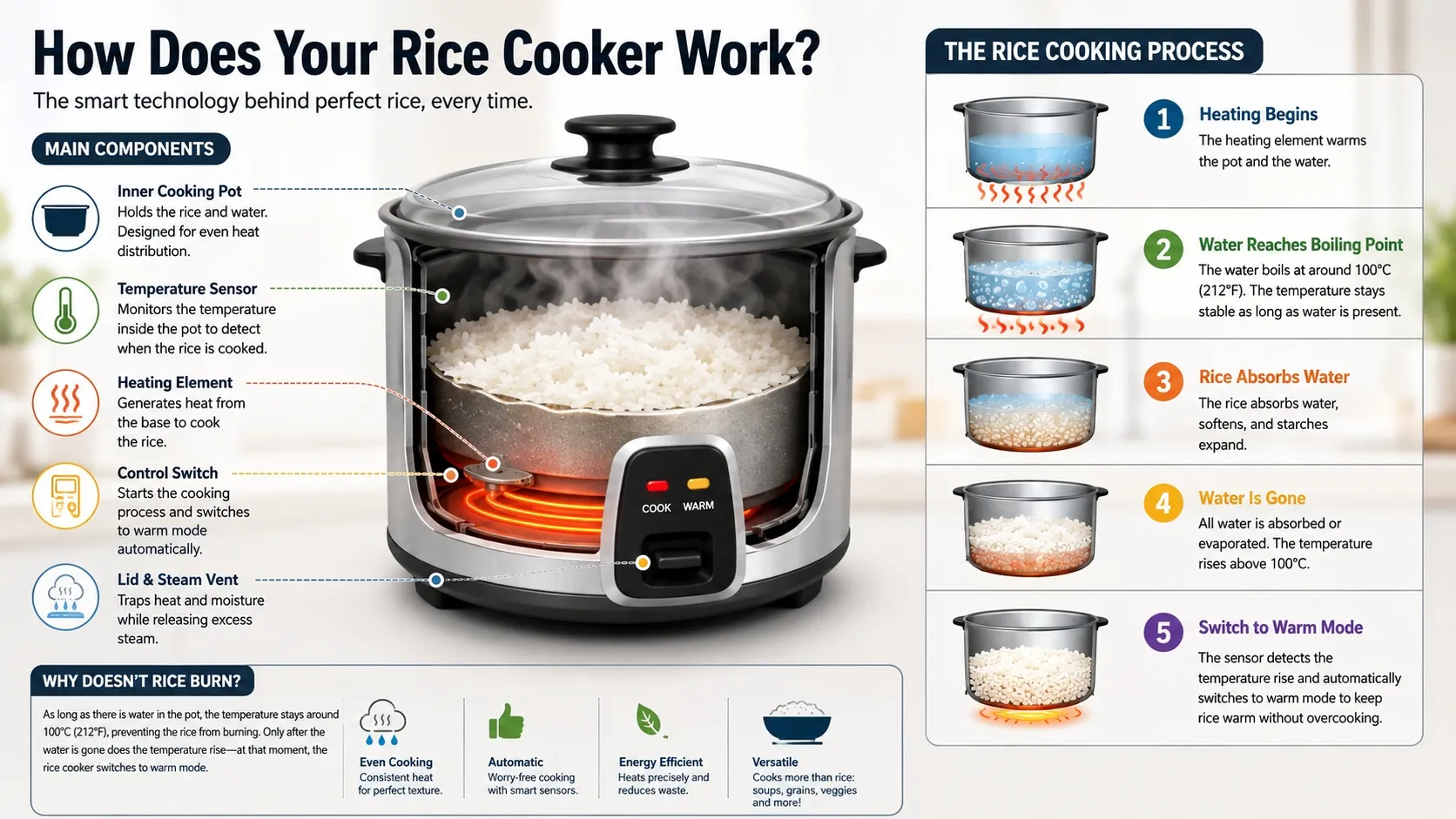
Learning how a rice cooker operates will enable you to make better use of it, select an appropriate rice cooker and even fix some cooking problems. In this guide, we will be taking a look at the science, parts, and cooking method behind rice cookers that makes them a reliable kitchen appliance.
What Is a Rice Cooker?
A rice cooker is an electric cooking pot that cooks rice on automatic settings, regulating the heat and temperature levels during cooking. Compared to cooking on the stovetop, a rice cooker has the ability to regulate the cooker's temperature and operation once the rice is cooked.
Today, there are rice cookers available that can cook a wide range of food items such as:
- White rice
- Brown rice
- Jasmine rice
- Sushi rice
- Quinoa
- Oatmeal
- Steamed vegetables
- Soups and porridge
The major benefit is the uniformity. Rice cookers are designed to cook rice without any guesswork to prevent under or over cooking or burning the rice.
Main Components of a Rice Cooker
It is essential to know the basic parts of a rice cooker to understand how it works.
1. Inner Cooking Pot
The inner pot is removable, and contains the rice and water. It is typically constructed of aluminum, stainless steel or non-stick coated materials that facilitate efficient heat transfer.
2. Heating Element
The heating element transforms electrical energy into heat, which is placed below the cooking pot. This is the main source of cooking energy.
3. Temperature Sensor
Under the inner pot is a thermostat, or thermal sensor. It continuously checks the temperature whilst cooking and is very important in deciding when the rice is ready.
4. Control Switch
The basic type of rice cooker will only have a Cook/Warm button. High-end models include digital controls, programmable settings and intelligent cooking functions.
5. Lid and Steam Vent
A lid will keep heat and moisture in and excess steam flowing out through a vent in the lid to ensure the best cooking conditions.
The Step-by-Step Rice Cooking Process
Rice cookers these days have a lot of fancy electronics, but they still work like this: it's very simple.
Step 1: Heating Begins
Press the Cook button and the electricity is sent to the heating element. The heat flows from the heating plate to the inner pot.
Slowly the water around the rice also gets warm and eventually boils.
Step 2: Water Reaches Boiling Temperature
Water boils at about 100°C (212°F) at normal atmospheric pressure. This is where the temperature within the pot is more or less constant.
An important principle in physics is:
The temperature then cannot get any higher when there is still liquid water in the pot since the energy is being used to vaporize the water, not raise the temperature.
Step 3: Rice Absorbs Water
Rice grains take on water and start to soften as the water is being boiled.
At the same time:
- Some water evaporates as steam.
- Some water penetrates the rice grains.
- Starches gelatinize and expand.
This stage is the one that is responsible for bringing that fluffy and soft texture that people look for in a well cooked rice.
Step 4: Water Is Gone
Eventually, all available water has either:
- Been absorbed by the rice, or
- Escaped as steam.
When all the water has been removed, the temperature in the pot starts to go above 100°C due to the lack of liquid water to keep the temperature in check.
Step 5: Automatic Switch to Warm Mode
This temperature increase is detected by the thermostat.
In the traditional rice cooker, a simple mechanical system automatically changes the cook mode to the warm mode, when the temperature gets up to a certain level. With digital models, sensors are electronic devices which serve the same function.
That's why rice cookers can cook without a timer.
Why Doesn't Rice Burn?
A frequent question is: why doesn't the rice catch fire before the cooker shuts down?
The solution is in the special thermal qualities of water.
As long as water is present, the heat during cooking will remain close to the boiling point. Rice is surrounded by moisture so that it does not scorch while cooking.
Once water has evaporated, the temperature quickly increases. The rice cooker knows at that time that the rice has been cooked and puts out less heat.
How Basic Rice Cookers Use Magnets
The design of many traditional rice cookers is rather ingenious.
In the cooker is a switch that is spring loaded and has a magnet attached. When the cooker is in Cook mode, the magnet holds the switch in position.
The cooking pot stays near 100°C as long as there is water in it. After the temperature exceeds a set value, the magnetic mechanism will weaken or break free, causing the switch to switch automatically to Warm.
The use of this simple design has been proven to work for decades.
How Modern Smart Rice Cookers Work
Today's top rice cookers have advanced technology in addition to thermostats.
Fuzzy Logic Technology
Fuzzy logic rice cookers feature microprocessors that constantly gather cooking information and adjust the cooking process in real time.
Benefits include:
- Better texture control
- More accurate cooking
- Adaptation to different rice varieties
- Improved consistency
Induction Heating (IH)
Induction heating rice cookers use a heating pot instead of just a heating plate, which generates heat directly in the pot.
Advantages include:
- Faster heating
- More even temperature distribution
- Better energy efficiency
- Enhanced flavor and texture
These features are commonly found in premium Japanese and Korean rice cookers.
Common Rice Cooker Mistakes
Even though rice cookers automate much of the process, user mistakes can still affect results.
Incorrect Water Ratio
Too much water creates mushy rice.
Too little water results in hard or undercooked rice.
Not Rinsing Rice
Excess starch can cause clumping and overflow during cooking.
Opening the Lid Too Early
Opening the lid releases steam and disrupts the cooking cycle.
Skipping the Resting Period
Allowing rice to rest for 5–10 minutes after cooking helps moisture distribute evenly throughout the grains.
Can Rice Cookers Cook More Than Rice?
Absolutely.
Modern rice cookers are highly versatile kitchen appliances capable of preparing:
- Quinoa
- Couscous
- Steel-cut oats
- Soups
- Stews
- Steamed vegetables
- One-pot meals
- Porridge and congee
Many households use their rice cooker daily because it simplifies meal preparation while producing reliable results.
Final Thoughts
While the exterior of a rice cooker might seem very simple, it's a device which utilizes clever temperature control and simple physics to generate a perfectly-cooked rice with little effort. The principle behind the appliance is to heat the water and when the rice uses up all the water, it senses the increase in temperature, which is used to determine that the water has been consumed.
From a simple one-button cooker to a more advanced fuzzy logic induction-heating cooker, the result is still the same: the perfect rice every time. Knowing the ins and outs of your rice cooker can help you get better results, prolong the life of your cooker and maximize the usefulness of one of the most important kitchen tools.


