





Fast-Food Outlets, Canteens, and Central Kitchens: A Daily Turnover Model for the 10L Pressure Cooker
In commercial food service, equipment is not just a tool — it is a production asset. The daily turnover rate of a cooking appliance directly determines how many meals it can help generate, how quickly the investment pays back, and whether it fits a specific business model. For the 10L Pressure Cooker, three distinct operational environments — fast-food outlets, canteens, and central kitchens — each demand a unique turnover model. Understanding these differences allows distributors and procurement managers to match the right capacity and features to the right client.
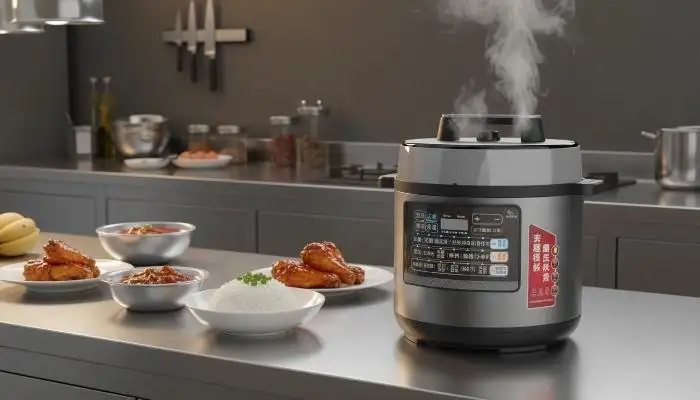
This article breaks down the daily turnover logic for each setting, using the IAIE Commercial Rice Pressure Cooker (10L Multi-Function Cooker) as the reference benchmark. We will also examine how IAIE's engineering choices — from unibody construction to one-touch quick release — support high-volume, consistent output.
Why Turnover Rate Matters for Commercial Buyers
Turnover rate refers to how many complete cooking cycles a pressure cooker can perform per day, and how much food (in kilograms or portions) it processes within operating hours. A higher safe turnover rate means lower cost per meal and faster return on investment.
• For a fast-food outlet: Every minute of waiting reduces sales. Quick cycles between batches are critical.
• For a canteen (corporate or school): Meal times are fixed. Predictable, batch-consistent output is non-negotiable.
• For a central kitchen: The pressure cooker must run continuously with minimal idle time, often across multiple shifts.
The IAIE 10L Pressure Cooker, with rated power from 701W to 1000W and a microcomputer touch control system, is designed to adapt its turnover rhythm to each of these scenarios.
Model 1: Fast-Food Outlet — Speed as the Primary Driver
A typical fast-food outlet (e.g., a quick-service rice bowl or stew shop) operates 10–12 hours daily, with two or three peak periods (lunch, dinner, possibly late night). Here, the 10L Pressure Cooker acts as a just-in-time production unit.
Daily Turnover Assumptions for a Fast-Food Outlet:
• Single batch volume: 8–9 liters of cooked rice or stew (leaving headspace for safe pressurization).
• Cooking cycle time (including pressure build-up, cooking, and one-touch release): 20–25 minutes for rice; 30–35 minutes for beans or tough meats.
• Average cycles per hour: 2 to 2.5 cycles (with rapid exhaust via IAIE's one-touch quick release).
• Operating hours: 10 hours (with brief idle periods between peaks).
Estimated daily output:
20–25 cycles × 8 liters = 160–200 liters of prepared food
(equivalent to roughly 400–500 rice portions or 250–300 stew servings).
Why the IAIE 10L Pressure Cooker fits fast food:
• One-touch exhaust button: Reduces cycle downtime by eliminating natural pressure release (saves 10–15 minutes per batch).
• Even heat distribution: Ensures consistent texture for repeated batches of rice or braised meats, reducing waste.
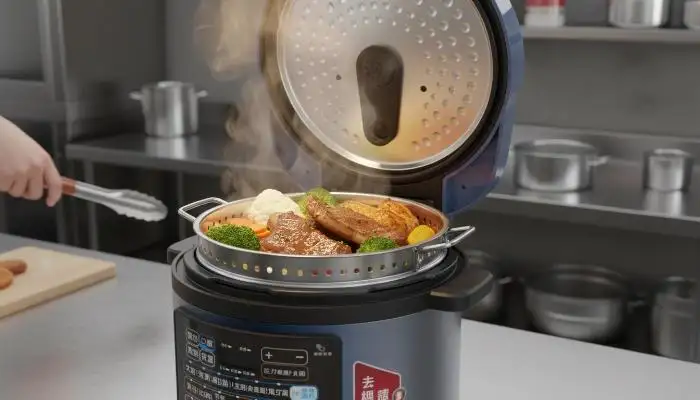
• Double non-stick steam tray: Simultaneously cook rice on top and stew below, giving double output per cycle.
• Key takeaway for distributors: In fast-food environments, the IAIE 10L Pressure Cooker can achieve 20+ daily cycles — translating to over 2,000 portions per week from a single unit.
Model 2: Canteen (Corporate, School, or Hospital) — Predictable Batch Sizing
Canteens face a short, intense serving window — typically 1.5 to 2 hours per meal, with total daily operation of 5–6 hours. The focus is not on cycle speed but on batch size accuracy and reliability. A 10L Pressure Cooker here is often one of several units working in parallel.
Elements Determining Daily Turnover for a Canteen (customers included 200-300):
• Cycle Size: 10 liter/cycle. Canteens frequently prepare rice, soup, or dal in bulk.
• Cycle time: 25-30 minutes (This includes a natural pressure hold with a quick release for serving).
• Daily Cycles: 6-8 (This will vary with breakfast as porridge, lunch as rice + main stew, and dinner as soup or lentils).
• Total output: 60-80 liters/day
Ways IAIE's design helps run a Canteen:
• Producing a Unibody Construction: Creates a stronger body that helps the pressure cooker withstand daily use, prevents deterioration of the seal and the lid.
• Microcomputer touch control: Allows for the use of preset programs for rice, stews, and for steaming. This is a huge benefit, as the kitchen staff are often very busy during meal service and plating.
• (Optional upgrade) Ceramic crystal inner pot: Reduces the issue of sticking and burning when preparing large volumes of rice or congee. That also enhances the effectiveness of cleaning the inner pot after each batch.
Sample Calculation:
• Suppose a school's canteen needs 150 liters of rice for lunch.
• This can be done using three IAIE 10L Pressure Cookers (each requiring 5 cycles).
• No need for large equipment, and no energy wasted.
• Major distributor benefit: Canteens require consistency. Due to its accurate control and strong heating element, the IAIE 10L Pressure Cooker achieves the same result every time.
Model 3: Central Kitchen — Optimized for Use Across Shifts
Central kitchens cook meals for various different locations far away from the central kitchen. (e.g., meal delivery services, airline catering services, or chain restaurants). In these instances, a 10L Pressure Cooker will be an integral part of a continuous production line that is often in operation for 16-20 hours a day, with two or three shifts of staff.
Daily Turnover Assumptions for a Central Kitchen:
• Batch volume: 9.5–10 liters (tight scheduling, minimal idle headspace).
• Cycle time: 20–28 minutes (using one-touch rapid release after every cook, plus automated cool-down between batches if needed).
• Cycles per day (two shifts, 18 hours): 35–45 cycles per cooker.
• Daily output per unit: 330–450 liters of prepared base ingredients (stocks, braised meats, par-cooked rice for finishing on site).
Elements for high usage featured in IAIE:
• Directly hooked power supply (fixed direct connection with non-detachable coupling): Prevents accidental disconnection during rush operations. Meets commercial safety requirements for continuous operation.
• Advanced packing design for better logistics: Allows centralized kitchens to order 50 to 100 units as one shipment. While advanced packing does not speed the cooking process, it is necessary for large scale operations.
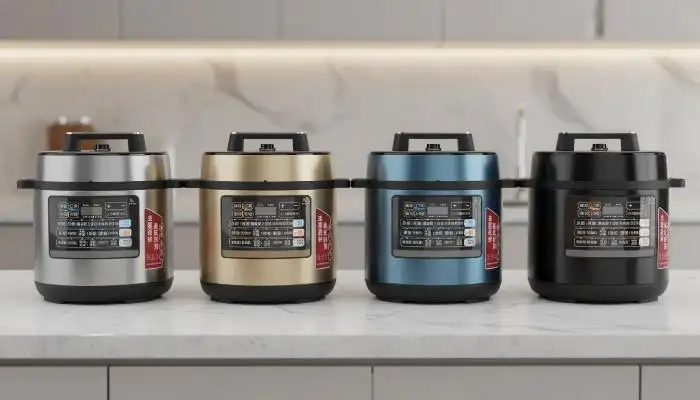
• Varied color options and custom branding: Central kitchens supplying assorted brands easily distinguish units by specific recipes or allergen protocols by requesting different exterior colors (gold, blue, black).
Real-world turnover comparison:
• A conventional stovetop pressure cooker might manage 12 cycles per day (due to manual heating and slow cooling).
• The IAIE 10L Pressure Cooker, with its integrated 1000W heating and one-touch exhaust, achieves triple the daily throughput in the same floor space.
✅ Key takeaway for distributors: For central kitchens, emphasize total daily liter output and mean time between failures — IAIE's unibody and fixed power cord directly address both.
Why IAIE Is Your Strategic OEM/ODM Partner for the 10L Pressure Cooker
Beyond the turnover models, IAIE offers procurement advantages that matter to wholesalers and distributors:
Unibody construction for maximum durability: Reduces warranty claims and returns, protecting your margin.
• One-touch quick release for safety & speed: A feature that fast-food and central kitchen operators will actively request once they see it.
• Multi-function cooking (soups, stews, rice, steaming): Makes the 10L Pressure Cooker a versatile sku that replaces multiple appliances — increasing your average order value.
• Premium inner pot options (ceramic crystal coated): Allows you to offer an upsell tier for high-end canteens and hotels.
• Custom branding & colors: Order in bulk -- choose between colors like blue or black stainless steel and get your logo printed on them. This turns a commodity product into a branded solution.
• Optimized packaging: Container loading calculations can reduce shipping costs by 12–18% compared to round-shaped competitors.
From concept to manufacturing, IAIE works as a strategic partner — not just a supplier. Whether your client runs a 20-seat fast-food outlet or a 50,000-meal-per-day central kitchen, the 10L Pressure Cooker (Model A, 8/10/12L) delivers the daily turnover rate that matches their business rhythm.
Final Comparison Table
| Business Type | Daily Cycles (IAIE 10L) | Daily Output (Liters) | Most Valued IAIE Feature |
| Fast-food outlet | 20–25 | 160–200 | One-touch quick release |
| Canteen | 6–8 | 60–80 | Microcomputer touch control + even heat |
| Central kitchen | 35–45 | 330–450 | Unibody durability + fixed power cord |
Ready to supply a 10L Pressure Cooker that adapts to any turnover model?
Contact us for wholesale pricing, custom color samples, and OEM/ODM terms. IAIE protects your privacy and responds within 24 hours.
FAQs
Q1. What can you cook in an IAIE 10L Pressure Cooker besides rice?
Various things. The IAIE 10L Pressure Cooker can also cook soups, stews, braised meats, and beans, and can steam food, too! In fact, there's no need for multiple other kitchen appliances.
Q2. Will the one-touch quick release system work in fast paced kitchens?
Yes. There is no need to move the release valve, making quick service possible with a lower risk for burns.
Q3. How is the standard double non-stick tray better than the ceramic crystal inner pot?
The ceramic crystal pot does have improved non-stick ability. If you make dishes that tend to be stickier like congee or sticky rice, that would be the better option.
Q4. Is there an option for custom orders with my brand logo on the 10L Pressure Cooker?
Yes. Customizations can be made as part of bulk purchases. IAIE offers gold, blue, black, or stainless steel as the available colors, as well as some limited logo options for our OEM/ODM partners.
Q5. What would you recommend as the best way to clean a pressure cooker for heavy use?
Cleaning is really easy because the microcomputer touch control panel is sealed and therefore easy to wipe. The removable steam tray and non-stick inner pot are dishwasher safe, making clean up easy.


