





history of pressure cookers
Pressure cooker has made itself a necessary kitchen appliance in every home in the world. These economical machines are famous for cutting cooking times, keeping nutrients and enhancing energy efficiency, which has revolutionized how people prepare their food. The tale of the pressure-cooker, however, covers well over three hundred years—and is significant for the many and significant achievements that have been made in science, engineering, and cooking.
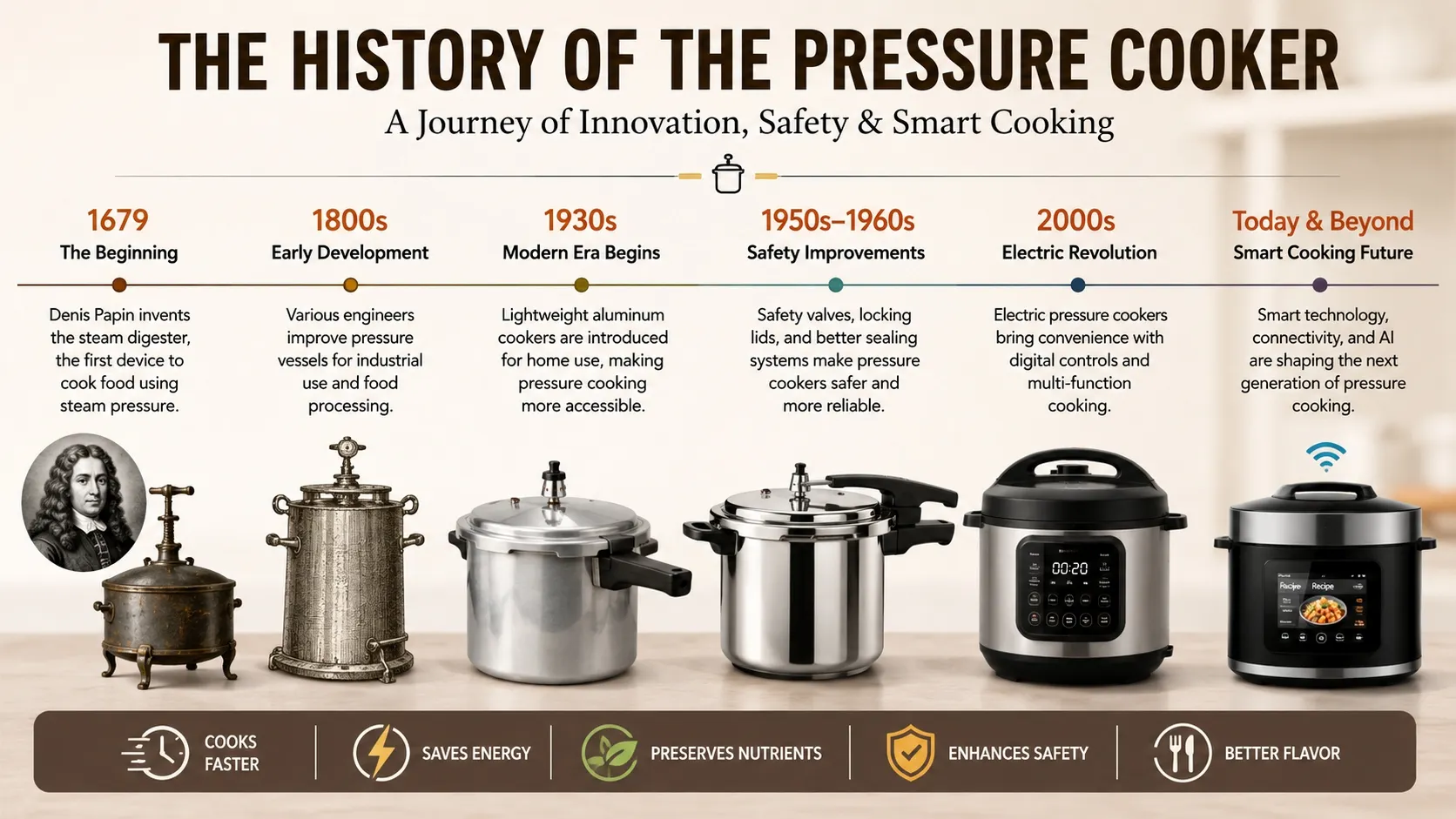
From the 17th century scientific experiment to the modern-day smart electric multicooker, the evolution of the pressure cooker can be traced in this article.
The Birth of Pressure Cooking Technology
The earliest known use of a pressure cooker is 1679 when the French scientist and inventor Denis Papin invented his “steam digester.” The design of the Papin's invention was to cook the food under high pressure in a closed vessel. This was accomplished by holding steam so the boiling point of water rose to allow food to be cooked much faster than "by old methods.
Papin's digester was originally designed as a scientific experiment to prove the force of steam pressure. The machine could break up the bones, and soften and cook hard bone meat in a few minutes, instead of the hours that it normally would take. This pioneering invention served many purposes beyond its immediate function in making a time-saving pressure cooker as well as a basis for the development of pressure engines.
The most important of Papin's contributions was the invention of a safety valve which enabled it to permit the excess pressure to flow away without causing dangerous explosions. In fact, this invention is still an essential safety in pressure cookers today.
Early Pressure Cookers: Powerful but Impractical
Impressive results were obtained with Papin's invention, but the early pressure cookers were not very convenient household appliances. The steam digesters were bulky, massive, cumbersome and also hard to manage. Their applications were mostly scientific research laboratories, industrial complexes and specific food processing companies.
The meaning of “pressure cooking” hasn’t changed a great deal over the past two hundred years. Experiments with sealed cooking vessels continued with still further modifications by engineers and inventors, but limited manufacturing production did not make widespread use possible. Made of cast iron, these gear-up tools were large, costly, and could be hazardous when not maintained properly.
At this time, pressure cooking was more closely linked to the industrial sterilization/food processing than to the domestic cooking experience.
The Rise of Household Pressure Cookers
With the 20th century came a pivotal moment for pressure cookers. Huge progress in steelwork technique allowed industry to supply the consumer with lighter, safer and more economic products.
Aluminum was other large substance added since it was a good conductor of heat and light. Producing the pressure cooker would now be possible which heated up in a time of minutes and were easier to handle. Consequently, pressure cooking found its way into the homes.
In the late 1930s a big step was made when the first modernisations in the model of Domestic Press cookers had occurred and were brought to the consumer's notice. When improvements in efficiency were increasingly important, these products made for quicker cooking, less fuel usage, and higher level of convenience.
A World War II invention, salted jars became popular during the war as families faced pressure to keep up with the "energy conservation" methods of preparing meals using pressure cookers. Following the war, such demand increased and the pressure cooker was everyday equipment in North American, European and Asian kitchens.
Safety Challenges and Technological Improvements
Though pressure cookers are becoming commonplace in many households, the early models were in danger of various types of accidents. Simple pressure regulation systems were typical with older models and they can often become clogged or fail. The demise of pressure cookers to something hazardous to consumers and undermining the public trust in the device shocked customers and hurt the confidence in pressure cookers.
In response to this, manufacturers have poured effort into creating ever safer innovations. During the 1950's and 1960's, there were several significant enhancements:
Advanced Pressure Release Valves
A new type of pressure release valves auto-regulate internal pressure, minimising the risk of over pressurisation.
Locking Lid Mechanisms
New designs to prevent cooker lid being opened when the cooker is under pressure.
Backup Safety Systems
Multiple layers of protection in case of malfunction, through additional pressure relief devices.
Improved Sealing Technology
Leaks were reduced and performance was improved with higher quality gaskets and seals.
These changes made the pressure cooker much safer and reliable and helped restore the consumer's faith. The models that are available today include several back-up safety devices, so that accidents have almost become impossible if used correctly.
Stainless Steel Revolution
Stainless steel quickly became the choice for high-end pressure cookers thanks to the advances of technology in manufacturing.
Aluminum, on the other hand, had some disadvantages compared to stainless steel:
- Greater durability
- Enhanced corrosion resistance
- Improved food safety
- Longer product lifespan
- More attractive appearance
Most of the pressure cookers available today have a triple-wall or multi-layer structure, taking the aluminium with the stainless steel core for better heat distribution and performance.
This change helped to develop the pressure cooker into a kitchen asset, instead of a quick craze.
Pressure Cookers Around the World
Different regions adopted pressure cooking technology in unique ways.
India
India became one of the biggest markets of pressure cooker, in the world. It was perfect for cooking lentils, rice, curries, beans and stews, which are only a few of the countless dishes that use pressure cooking. In modern times, a pressure cooker is an indispensable utensil in every kitchen of the Indians.
Europe
Consumers in Europe loved to use pressure cookers to prepare soups, braised meats and their traditional slow-cooked dishes.
North America
Pressure cookers have been around for years, but were once popular and then unpopular, before resurging in popularity like all other kitchen tools after being sought for healthier faster cooking and energy efficient cooking tools by consumers.
The Digital Age: Electric Pressure Cookers
The most significant change in pressure cooking came in the 21st century when electric pressure cookers started to emerge and the multifunction cooking systems were introduced.
Compared to conventional pressure cookers, electric pressure cookers include:
- Digital controls
- Automatic pressure management
- Preset cooking programs
- Delayed start functions
- Keep-warm settings
- Multiple cooking modes
Modern units often combine several appliances into one device, functioning as:
- Pressure cookers
- Slow cookers
- Rice cookers
- Steamers
- Yogurt makers
- Sauté pans
The convenience and versatility of this has kept pressure cooking within reach for all. Backed by the pressure cooking method, consumers can reap the advantages of the cooking process without the need for huge experience or supervision.
Why Pressure Cookers Remain Popular Today
Despite the incredible advancement of technology, pressure cookers are still widely used as they cater to a few major requirements of today's homes.
Faster Cooking
There are times when eating meals take less than an hour.
Energy Efficiency
There's less energy going into the microwave when it cooks a meal in shorter times.
Nutrient Preservation
Faster cook times will help to retain vitamins and minerals that may leach out with extended cooking times.
Better Flavor Development
Pressure cooking enhances the flavors, which come forth from the materials inside of the cooking vessel, since it is trapping moisture and aromatic compounds in the pressure vessel.
Convenience
The latest electric versions offer programmability and automation, which reduces the workload that this activity involves for chefs.
Despite the convenience and ease of modern electric pressure cookers, the pressure cooker has not lost its relevance in the modern kitchen in view of consumers' increasing obsession with efficient cooking and sustainable food sources as well as growing a healthy diet.
The Future of Pressure Cooking
Smart technology and connected technology may have implications on the future of pressure cookers. Next generation cooking devices are being enhanced with wireless, automation, mobile control and AI.
Other upcoming pressure cookers can automatically sense the type of ingredients, quantity of ingredients, altitude, and want texture, and adjust cooking conditions automatically, so home cooking will be even easier and more precise!
It started with Denis Papin's trying to cook at the Royal Society in 1679, and has developed into one of the most sophisticated and usable cooking techniques known today. The pressure cooker has been through centuries of innovation and development, yet it has consistently served its original purpose: that of cooking food in a rapid and efficient manner, and subsequently, to culinary perfection.
With the rise of culinary technology, the inspiration to invent a pressure cooker particularly continues to stand out as illustration of the importance of innovation and innovation in every part of daily life.


