





how to pressure cookers work
The advent of the pressure cooker in modern kitchens has made cooking of delicious meals simple and within a few hours. From preparing a tender cook beef stew to a cooked bean, to a flavored soup, a pressure cooker can cut through cooking time while maintaining flavor and nutrition.
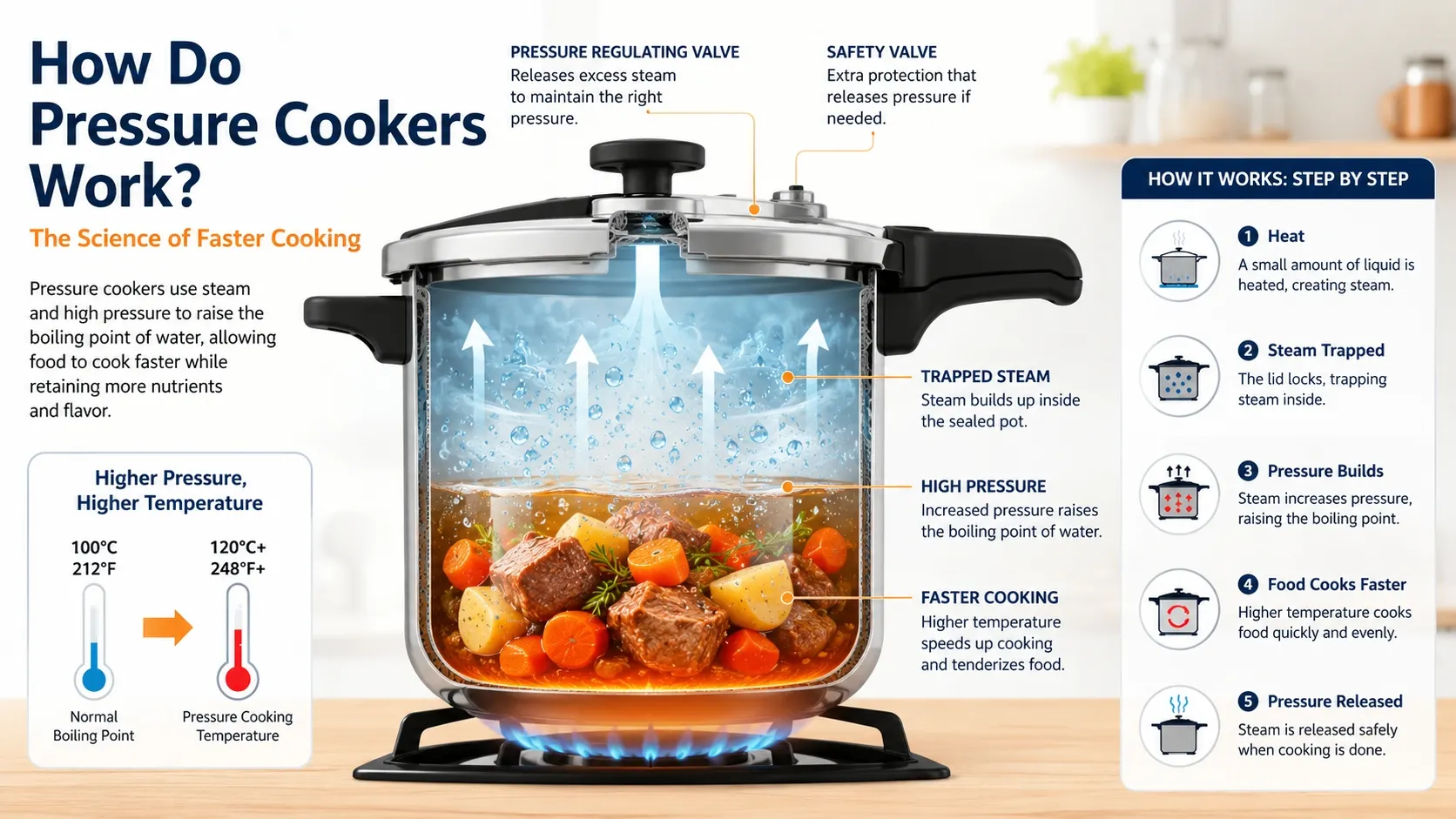
However, what are the working principles of a pressure cooker?
The key to cooking food at above normal temperatures of boiling of water stems from a simple yet powerful scientific fact, “the higher the pressure the higher the cooking temperature” of water. This heat, steam and pressure produce one of the most effective and modern cooking processes.
What Is a Pressure Cooker?
A cooker with a closed top in order to hold steam from boiling liquid. Unlike a normal pot, where steam can escape into the air, a pressure cooker does not permit steam to escape, thus building up high pressure.
Pressure cookers consist of the following:
- A heavy-duty cooking pot
- An airtight locking lid
- A sealing gasket
- Pressure-regulating valves
- Safety release mechanisms
Working together these components can safely withstand pressure during cooking and cook food more quickly and efficiently than typical methods.
The Science of Pressure Cooking
It aids to know a little about boiling water to better understand how a pressure cooker works.
At sea level, the boiling temperature of water is 100°C or 212°F. At this temperature, more heat will boil off the water, but won't raise its water temperature.
This is where a pressure cooker comes in.
Steam does not escape, so the pressure increases inside the pot. The higher the internal pressure the higher the vaporization temperature of water. Most pressure cookers can heat water to approximately the temperature of 120°C – 121°C (250°F).
It is because of this higher cooking temperature that it cooks more quickly.
Step-by-Step: How a Pressure Cooker Works
1. Liquid Is Heated
Each Pressure Cooker needs a little bit of liquid, like water, broth or stock. When heated, the liquid will start boiling and generate steam.
2. Steam Becomes Trapped
Sealed lid does not release steam. The pressure in the cooker starts to increase as the steam is produced.
3. Pressure Raises the Boiling Point
The pressure has the effect of raising the boiling temperature which causes water to stay liquid at a much higher temperature. Food can cook at around 120°C, rather than 100°C.
4. Food Cooks Faster
Chemical reactions in food occur faster at high temperatures. Proteins become more easily broken down, vegetables become softer and tough connective tissue in meat becomes tender in much less time.
5. Pressure Is Regulated
The modern pressure cooker has a pressure release valve that will open at a certain pressure to relieve the pressure. This ensures a safe and steady cooker functioning.
Why Does Food Cook Faster in a Pressure Cooker?
The major one is temperature.
Unless in a traditional pot, boiling water will not reach a temperature over 100°C at sea level. The water temperature does not change even if the heat is turned up.
But, inside the pressure cooker, the higher pressure means the boiled water has a higher temperature. Cooking temperature is as high as around 120℃, which greatly accelerates cooking.
As a result:
- Dried beans cook in a fraction of the usual time
- Tough cuts of meat become tender faster
- Soups and stews develop rich flavors quickly
- Whole grains cook more efficiently
Many foods can be prepared 50–70% faster than with conventional cooking methods.
How Steam Improves Cooking Efficiency
The Steam is a key element in pressure cooking.
Dry air is not a good conductor of heat and, as it does little convection, it is a poor heat transfer medium. Steam circulates inside the cooker, heat is evenly distributed, and it circulates continuously around the food.
This ensures an even cooking and helps to avoid undercooked middle and dry outer portions.
A sealed environment also helps to reduce moisture loss, which will keep your food juicy and flavorful.
Types of Pressure Cookers
Stovetop Pressure Cookers
These are stovetop models that are gas, electric, or induction. In general, they will deliver higher pressure and temperature, which means slightly shorter cooking times as well.
Advantages include:
- Faster cooking
- Greater pressure control
- Durable construction
Electric Pressure Cookers
Electric pressure cookers (multi-cookers) come with built-in heating elements and computer controls. They are usually run at slightly below standard pressures, but provide excellent conveniences and safety features.
Benefits include:
- Automatic cooking programs
- Timers and delay-start functions
- Easy pressure regulation
- User-friendly operation
Are Modern Pressure Cookers Safe?
Pressure cookers are still linked to hard-to-swallow, kitchen mishaps. Fortunately, current pressure cookers aren't as dangerous as their predecessors.
The most recent pressure cookers have numerous protection features, including:
- Locking lids
- Pressure release valves
- Backup vent systems
- Overpressure protection
- Temperature monitoring
The mechanisms keep the pressure from getting to excessive levels, and under supervision by the manufacturer, modern pressure cookers are very safe to operate.
Does Pressure Cooking Preserve Nutrients?
Pressure Cooking ranks among the healthiest cooking techniques around, and can reduce cooking times by 75% for many recipes.
These are more likely to be retained than if they were boiled for a longer period of time, as food cooks quickly and requires less water. The closed cooking system also prevents exposure to oxygen and can decrease some nutrients.
This is a good reason why pressure cooking is great for vegetables, legumes, whole grains and nutrient-rich dishes.
Final Thoughts
Pressure cookers operate on the principle that more pressure is less release of steam making the water's boiling temperature rise. This permits the food to reheat at elevated temperatures than convetional methods, and greatly shortens the cook time, maintaining flavor, moisture and nutrients.
Elucidate the science behind pressure cooking to maximize the use of the versatile kitchen gadget, irrespective of whether you select a model that attaches to the stovetop, or a high-tech electric pressure cooker. Whether you are making dinner on a busy week night, meal prepping or spending time with your family, a pressure cooker can help you to make tasty, home-cooked foods faster and more efficiently.


