





How to Choose and Use an 8 Quart Pressure Cooker
The 8 quart pressure cooker is between the regular family size and the extra large batch cookers. It provides additional space to prepare soups, meat, beans and more without being as large as many 10 or 12 quart appliances.
That extra capacity is handy, but if it doesn't reflect the typical user's cooking habits. A large pot that is seldom full uses up a lot of space and may not work as well when you want to use a small batch.
When considering this size, evaluate the product's capacity, fill limit, recipe capacity, and kitchen space.
Solve problems involving Actual Capacity.
There are 7.57 liters in 8 US liquid quarts. For product categories that are consumed in practice, consumers might be confronted with a cooker of 8 quarts, while the size is being marketed as 7L or 8L.
These measurements are rather similar, but they are not the same. Product descriptions should explicitly list what the manufacturer rates the product to hold, and not assume that quarts and liters can be used interchangeably.
L4P Tech classifies its larger size family models under its 6–8L electric pressure cooker category. The actual inner-pot volume of the chosen model needs to be confirmed by the buyers.
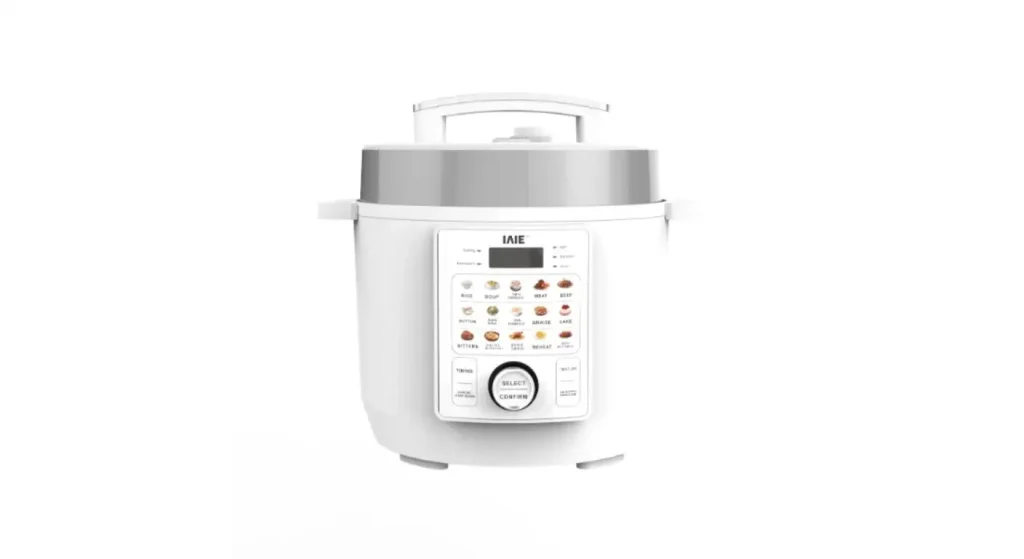
Consider Usable Volume, NOT Rim Capacity.
The inner pot does not allow to cook the entire amount of it. Pressure Cooking needs a little space for steam to be produced and for controlling the pressure.
A normal maximum fill limit can be applied to soup, meat and firm vegetables. Foods that swell or foam, such as beans, grains and other, tend to need larger headspace.
Always use fillings and instructions in accordance with the appliance. Just because ingredients fit in an 8 quart cooker does not mean that it should be filled to the top.
Identify the Best-Fit Household (Bottom Up)
For larger families, many guests and those who make multiple meals at a time, an 8 quart pressure cooker may be preferable. It also gives flexibility to the bulky ingredients.
If your family is small and you routinely cook meals in the stock, beans, soups, and freezer, you will realize a savings. If you mostly cook a one or two servings though, a 4 – 5L electric pressure cooker might be easier to use and store.
Capacity should be based on the largest meal cooked on a regular basis, not something that is an occasional occurrence, once or twice a year.
Select Recipes That Use the Extra Space
The usefulness of an 8 quart pot is evident when you have recipes requiring space for liquids to move around or filling expansion.
Can be used to cook larger quantities of chili, curry, soup, stew, rice, porridge and beans. This could also be a large cut of meat or a whole chicken with food stacked on top of the liquid and steaming.
The size of the cooker and amount of fill it can hold is still significant. If using a bulky ingredient, measure it first, before assuming that it will fit under the lid without interfering with the pressure parts.
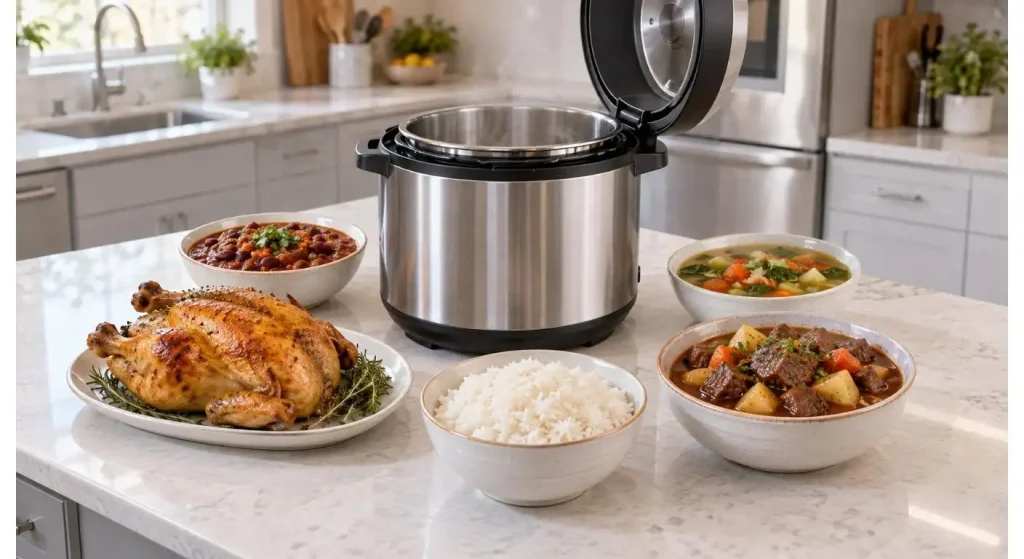
Use Performance with Small Portions to check the performance.
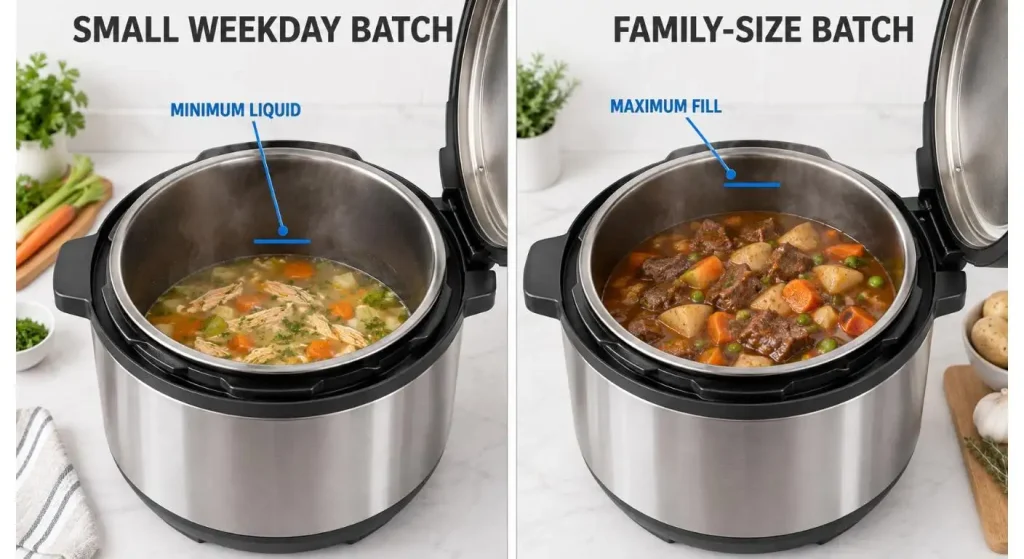
Don't determine the size of a large cooker solely by its max batch. Many consumers will switch between family size serving portions at meals and smaller portions during the week.
Inquire if there is a minimum amount of liquid requirement stated in the model, and if the programs are consistent when using lesser amounts. Small amounts can be smeared on the bottom of a large inner pot.
It's important to test a regular family meal as well as a smaller batch to get a real sense of what it would be like in the everyday family.
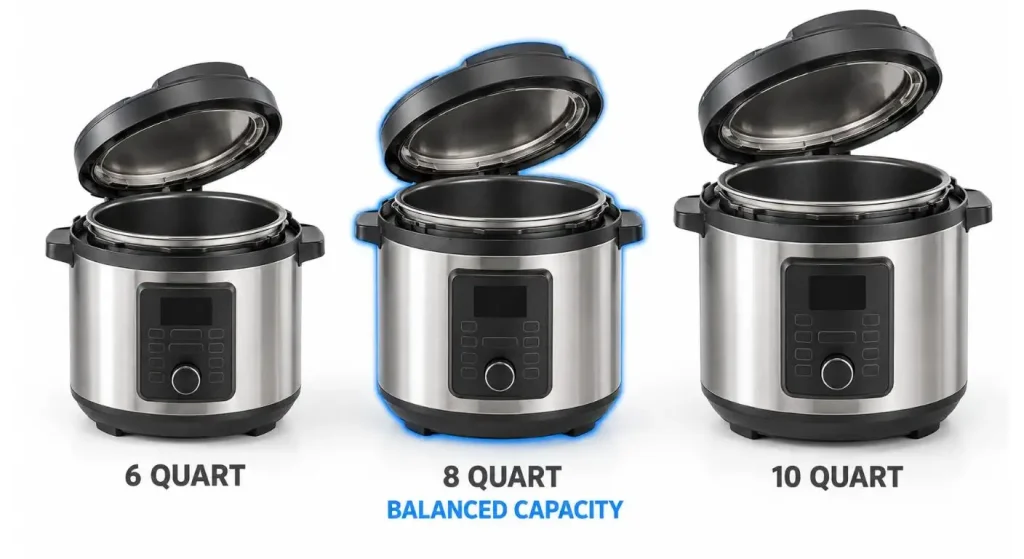
Compare sizes of 6, 8 and 10 Quarts
You will typically find it easier to lift, clean and store a 6 quart cooker. An 8 quart version provides additional space before going to the largest countertop size. A 10 quart model will allow for larger batches but will need to be accommodated on a larger countertop and storage space.
Household size is not the only factor that determines the best choice. The frequency of cooking, as well as the type of recipe and meal preparation habits are also important.
L4P Tech's 10-12L cooker range might be more suitable for preparing large quantities for food service, than an 8 quart cooker used by a family.
| Capacity | Best-Fit Cooking Pattern | Main Advantage | Main Trade-Off |
| 6 Quart | Regular family meals | Easier handling and storage | Limited space for large batches |
| 8 Quart | Larger meals plus weekly meal prep | Balanced capacity and versatility | Larger countertop footprint |
| 10 Quart | Frequent entertaining or bulk cooking | Fewer repeated cooking cycles | Heavier cleaning and handling |
| 12 Quart | High-volume or selected food-service use | Maximum batch space | Requires substantial storage space |
Check Heating and Pressure Time.
Cooking times shown are typically from the time after the cooker has reached operating pressure. If you use a larger pot or one that is not full, it may take longer to preheat.
The amount of liquid in a cooker can also slow down the natural pressure release. When using the device, users need to take into account the total elapsed time and not just the programmed pressure stage.
Test heat, hold and release pressure with realistic quantities. There should be no great difference in the texture of food at the top and bottom of the pot.
Choose Functions For Everyday Meals
Cooking programs may be rice, soup, porridge, beans, meat or stew and steaming. Delay start and keep warm can provide aid for family scheduling and batch preparation.
The clarity and consistency of the presets is more important than the number. Switching from smaller meals a day to full pot recipes should not prevent the controls from being understood.
A multi-functional pressure cooker offers a variety of cooking options but each mode should be reviewed with the food to be cooked.
Determine Kitchen Space
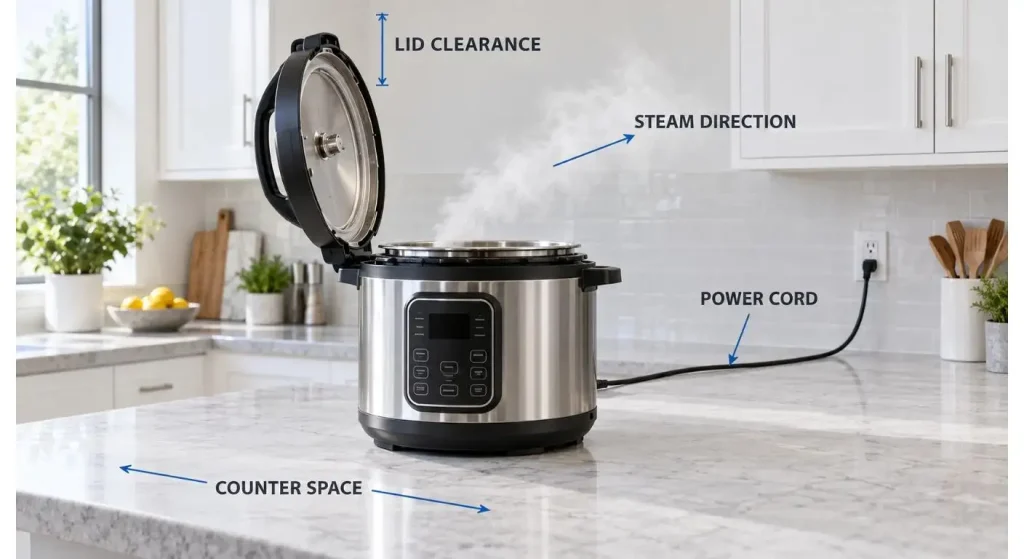
More than enough counter width is required for an 8 quart cooker. Allowing for lid opening, side handles, the power cord and safe steam release should also be considered when using the product.
Don't place the appliance under cabinets or next to walls that might be exposed to steam regularly. Cooker must be placed on a firm, flat and heat-resistant surface.
Don't forget to measure storage space, either. If the appliance can't be left on the counter, make sure that it can be moved around and put away in a comfortable position.
Consider Cleaning and Handling
The inner pot has a large weight when food and liquid is added. If possible, cooker should be positioned close to the use area prior to adding ingredients.
Depressurise and cool the appliance after use. Wash the sealing ring, lid channel and removable valve parts as per manual.
See if there are replacement sealing rings and inner pots. These factors impact the convenience of use of a larger cooker in the long run.
If unsure, try out the size first.
Cook at least two typical meals before making the determination on whether the capacity is sufficient. The first should be the normal family portion and the second should be the largest batch of people that can be expected.
Note volume of ingredients, preheating time, cooking time, release time and the end product texture. Take into account lifting, serving, cleaning and storage.
The L4P Tech recipe section offers a variety of examples of the cooking stages for rice, chicken/braised dishes, which can be used to structure practical product tests.
Conclusion
For bigger families who make meals regularly, a 8 quart pressure cooker could be a good middle-ground choice. It will provide more flexibility than a regular cooker, but won't necessarily take up the space of a 10 or 12 quart cooker.
Check the exact amount of litres, the fill level allowed, small batch performance and kitchen size before buying. Best capacity—one that suits normal weekday meals and really frequent large batch needs.
FAQ
Q1. How many litres are in the 8 quart pressure cooker?
The approximate conversion is 7.57L is the equivalent of 8 liquid quarts of water in the United States. Products labeled 8L are somewhat bigger, be sure to check the unit.
Q2. Is it possible to use an 8 quart pressure cooker for smaller dishes?
Yes, as long as the minimum liquid requirements are met. Try sampling small amounts as different pots and different types of programs may have different performances.
Q3. How much does an 8 quart cooker hold?
While there are many models that can fit a whole chicken, it will depend on the size of the chicken. The lid or pressure parts should not be affected by the food.
Q4. Which is bigger 8 quart or 6 quart?
Great for larger batches, but takes up more space and is heavier to carry when handling. For smaller meals each day, a 6 quart cooker might be more convenient.
Q5. Does this mean that I can fill an 8-quart pressure cooker to the top?
No. Do not fill up the headspace that the manufacturer specified, particularly for grain, beans and other foods that tend to swell or foam.


