





A Buyer’s Guide to Wholesale Industrial Electric Pressure Cookers
More than pot capacity and price per unit are factors that industrial electric pressure cooker wholesale buyers must consider. Restaurants, canteens, catering and institutional kitchens need equipment that can be repeatable to produce batches of food in frequent operation.
Many product descriptions use the term ‘industrial' generically. Some products are in fact true production machines, others are large capacity counter-top products designed for light and medium food service applications.
Buyers are advised to specify the batch size, frequency of operation, menu, cleaning procedures before ordering. These details will make the difference between whether a cooker is suitable for the actual kitchen or not, as well as just being big enough.
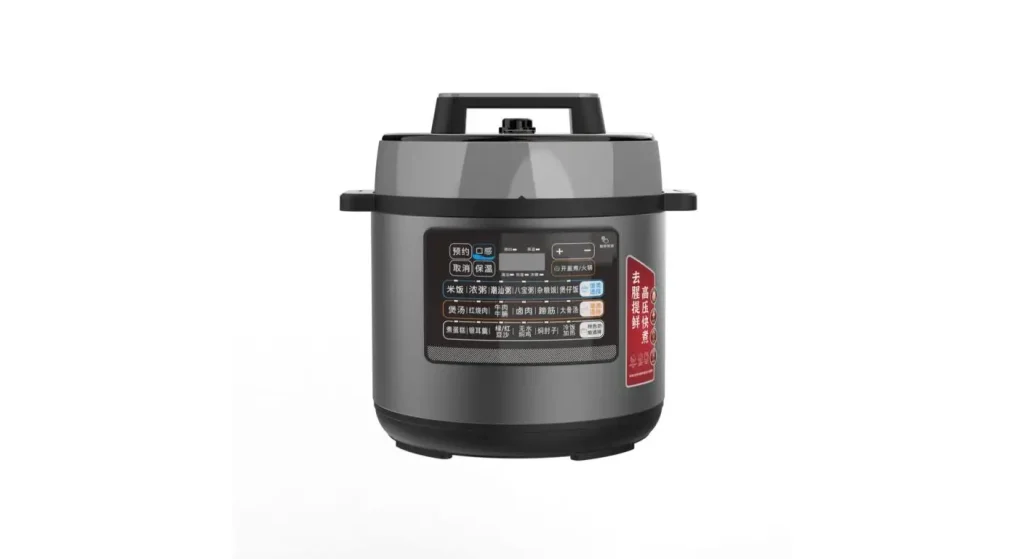
Clarify What Industrial Means for the Application
The best definition for an industrial electric pressure cooker is by the amount of work it can do. The buyer is required to state the number of batches for the appliance each day, amount of food cooked in each batch and the speed at which the staff requires the next batch to be ready.
For cafés, small restaurants, preparation for catering and canteens an 8–12L countertop model can be used. Don't automatically suggest it's an alternative to a much bigger commercial pressure vessel.
The 10–12L size range of electric pressure cookers from L4P Tech offers large capacity options for batch cooking. Buyers are advised to correlate these models with service demand in order to discuss wholesale quantities.
Calculate Output on Usable Batch Size
Nominal pot capacity does not necessarily reflect the volume of food that can be stored. Space for steam to build up is required for pressure cookers, and foods that expand or foam may require less filling level.
Find output, given the actual recipe. Write down the weight of the ingredients, volume of the liquid, cooking time, pressure-release time and cleaning time. This will give a better idea of portions per hour.
A cooker taking a long time to cook one product might not be as useful as two smaller cookers running concurrently to cook the same product. Wholesale buyers need to compare workflow, rather than just the capacity.
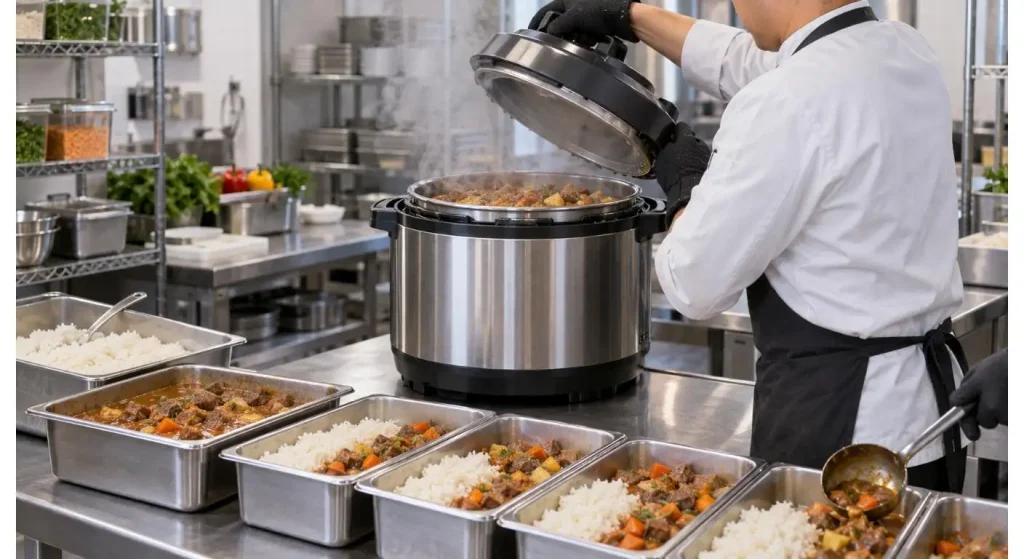
Run repeated cooking cycles to verify test.
One successful cooking test is not considered to be restaurant use. Sample evaluation should consist of a number of successive cycles with the same recipe and filling level.
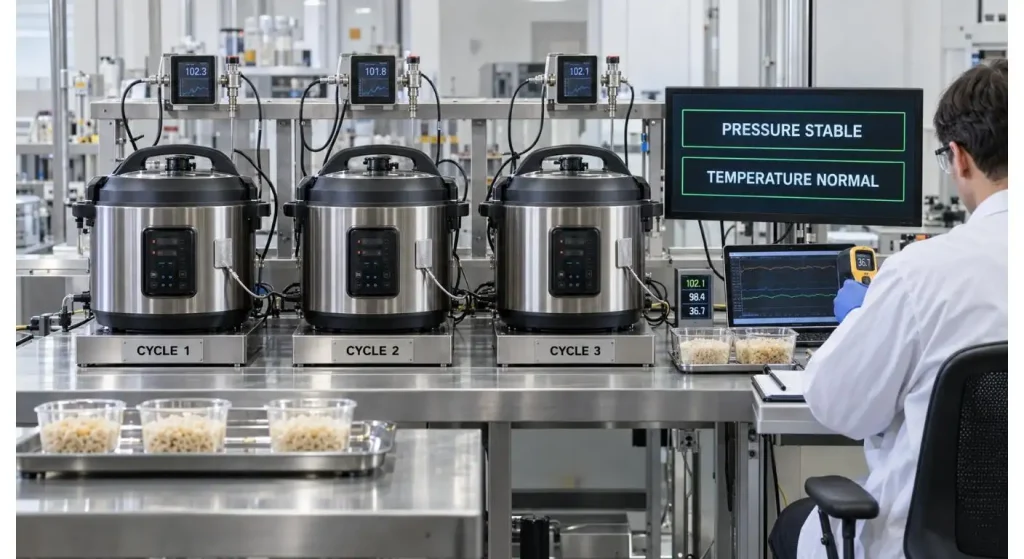
Time to reach pressure, pressure-holding stability and texture of food from various places in the pot. Analyse differences between the first and the last sample to see how the heat has affected them.
Repetitive operation must also be checked of controls, handles, lid parts and housing. If surface temp is too high, pressure release time is too long or heating is not consistent, further investigation is necessary prior to approval.
| Test Item | Test Condition | Information to Record | Review Indicator |
| Pressure build-up | Same recipe and fill level | Minutes to reach pressure | Variation between cycles |
| Batch consistency | Three consecutive cycles | Texture and doneness | Uniform or inconsistent |
| Pressure release | Normal post-cooking release | Release time and steam direction | Controlled or review |
| Housing temperature | Final cycle at full load | Accessible surface condition | Acceptable or excessive |
| Cleaning turnaround | Complete normal cleaning | Minutes before next batch | Practical or too slow |
| Control response | Repeated program selection | Errors or delayed input | Stable or unstable |
Match Functions to Food-Service Menu
Commercial buyers don't require all the cooking programmes. They require reliable options on the dishes that are regularly sold.
Common batch-cooking applications are rice, soup, porridge, beans, curry and meat and stew. A commercial rice pressure cooker can be used for many of these menu items, and will eliminate the need to have multiple counter-top appliances.
Cook each priority dish with the actual size portion and food from the kitchen. Service operating team should verify if the preset programs need to be manually altered during service.
Review Workflow Usability
Many employees of a restaurant will use the equipment, some of whom may be inexperienced. There should therefore not be controls during busy periods.
The staff members should be aware of the procedure of closing the lid and choosing a programme, as well as knowing how to perform the operation safely depending on the stage of operation and release the pressure. While one-touch exhaust can help to streamline workflow, exhaust should be kept clear of the operator and adjacent equipment.
Watch a user who hasn't been involved in product development. If this individual still is unable to cook a normal cooking cycle after a short period of teaching, the interface or training material must be improved.
Check if cleaning and turnaround requirements are there and if they are fulfilled.
The amount of cleaning time is related to the number of batches that can be finished in a kitchen. Humectant should be examined by the buyer in the inner pot, sealing ring, pressure valve, lid channel and condensation collector and surrounding housing.
Removable parts should be easily accessible without the need of complicated tools. There should be no tight spaces where food residues can be allowed to accumulate and are not easy for staff to check.
The material of inner-pot should be chosen based on the type of menu and cleaning. Coated pots help to release food easily and stainless steel might be desirable where abrasion resistance and intensive cleaning are important.
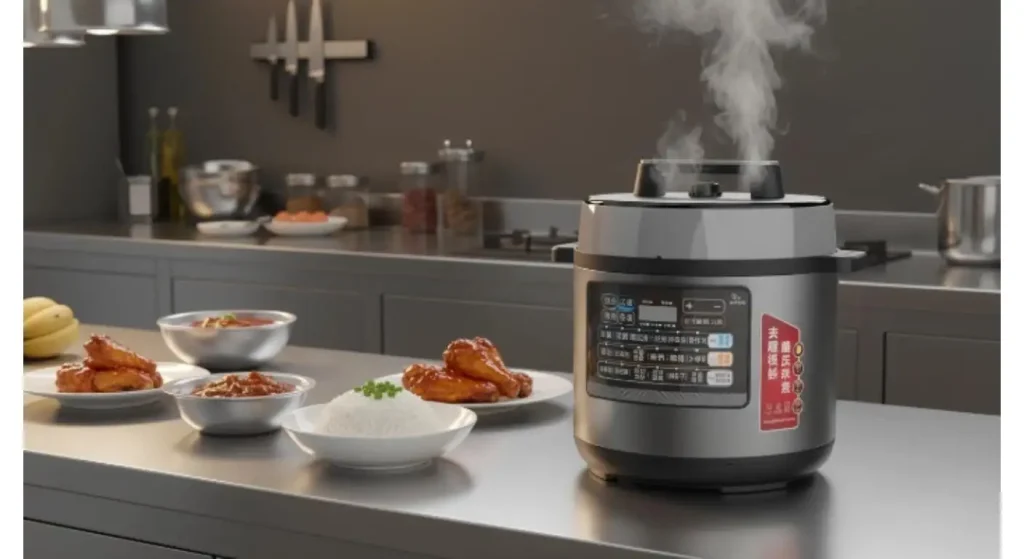
Check the Safety System under REAL Conditions
If the appliance is used commercially, the safety components will be under greater stress as it may be used many times during the day. Test the lid locking mechanism, pressure adjustment, overheat prevention and steam release mechanism.
You should test the normal cooking, maximum filling and any applicable abnormal conditions. Some blocked vents, damaged sealing rings and incomplete lid closure should be addressed by having the Buyers request clear instructions.
The manufacturer should make the functional, pressure and sealing checks during the manufacturing process known. On its electric cooker manufacturer page, L4P Tech details its method of cooker inspections and manufacturing capabilities.
Plan OEM Details for Wholesale Distribution
Customized logos, colors, control panels, manuals, rating labels and cartons can be ordered as a wholesale option. Make sure to define these items prior to sample approval.
Electrical ratings and plug types and compliance markings should correspond to the destination market. Avoid a single packaging design for multiple models if the capacity, power and accessory details are not able to be easily distinguished.
Product appearance and packaging can be customized to a distributor's market via the OEM and ODM pressure cooker services. The safety critical components should not be modified in customization without retesting.
Measure the effectiveness of packaging and containers
Packaging has an impact on landed cost and damage rate for wholesale orders. Ask for the packed size, gross weight, units per carton and container loading quantity of the specific configuration.
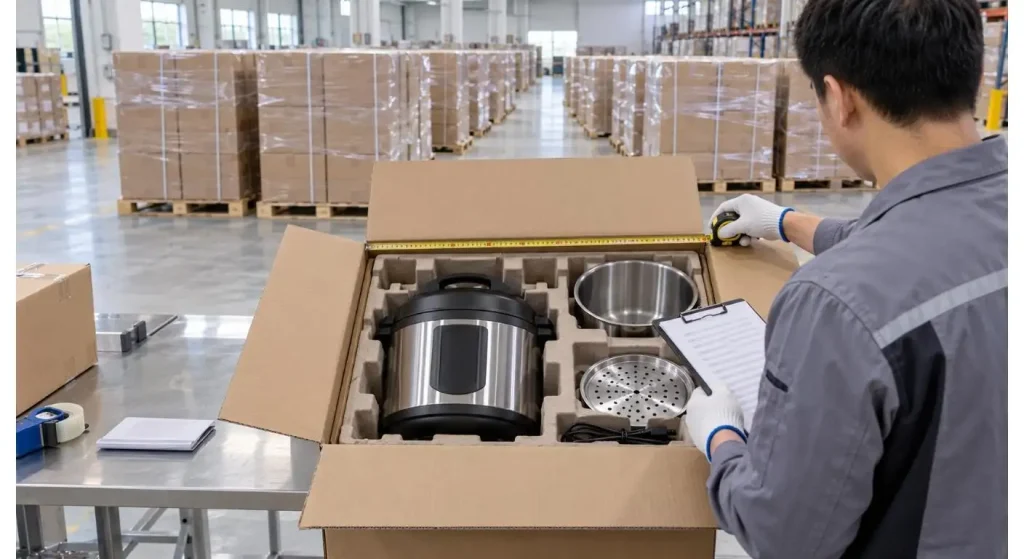
Inner pots, steam trays, power cords and other accessories should be firmly fastened, to prevent damage to cooker during transportation. Testing of boxes for stacking and normal distribution handling should be performed.
Check packaging after trial shipment/transport simulation. A cooker may not be damaged but may cause a significant amount of cosmetic damage, therefore returns.
Explain what Spare Parts and Warranty Handling are.
Pre-planning of after-sales is required prior to shipping. Verify the warranty period, technical response process and availability of sealing rings, valves, inner pots, control board and heating related components.
How defects will be resolved and documented should be agreed upon by the supplier and distributor. Photos and videos, serial numbers and failure descriptions can help technical assessments to be made more quickly.
In many instances, it is more convenient to ship a spare parts package instead of shipping whole appliances internationally. A dialogue on commercial terms can be held on the manufacturer's contact page.
Conclusion
When buying electric pressure cookers for industry, keep in mind their performance over time and how useful they are in your kitchen, in addition to their capacity.
Try out real recipes, check cleaning & safety information, check packaging & establish after-sales service prior to purchasing in bulk. A well-drafted specification will help you to compare quotations and minimise risk of operation after the distribution.
FAQ
Q1. What size pressure canner would you use for commercial pressure cooking?
It varies from the recipe and the amount of doses per hour. If an 8–12L model is sufficient for the needs of the café or canteen, then it can be used instead of the 12–18L model for smaller food-service operations.
Q2. A large capacity cooker is always industrial?
No. Industrial suitability also relates to the operating frequency, construction, safety performance and cleaning requirements (and durability under repeated cycles).
Q3. What needs to be tested prior to wholesale order?
Full load cooking, consecutive cycles, pressure release, temperature control and cleaning turnaround tested. Approval of packaging and electrical configuration needs to be granted as well.
Q4. Are industrial electric pressure cooker customizable?
OEM orders can include such things as logos, colours, control panels, manuals and packaging. Technical changes should be considered with regards to safety and compliance.
Q5. What are wholesalers to stock up on?
Typical services are sealing rings, valves, inner pot and specific electrical parts. The final spare-parts list should be the same as the model approved.


